The first time Mira entered the old archives, she thought it was just another forgotten chamber. Dust was floating through narrow beams of light, and the air smelled faintly of ashes and ink. The silence there felt too deep, as if the room itself had been waiting for her. Somewhere far above, drops of water were falling slowly, echoing through the endless corridors.
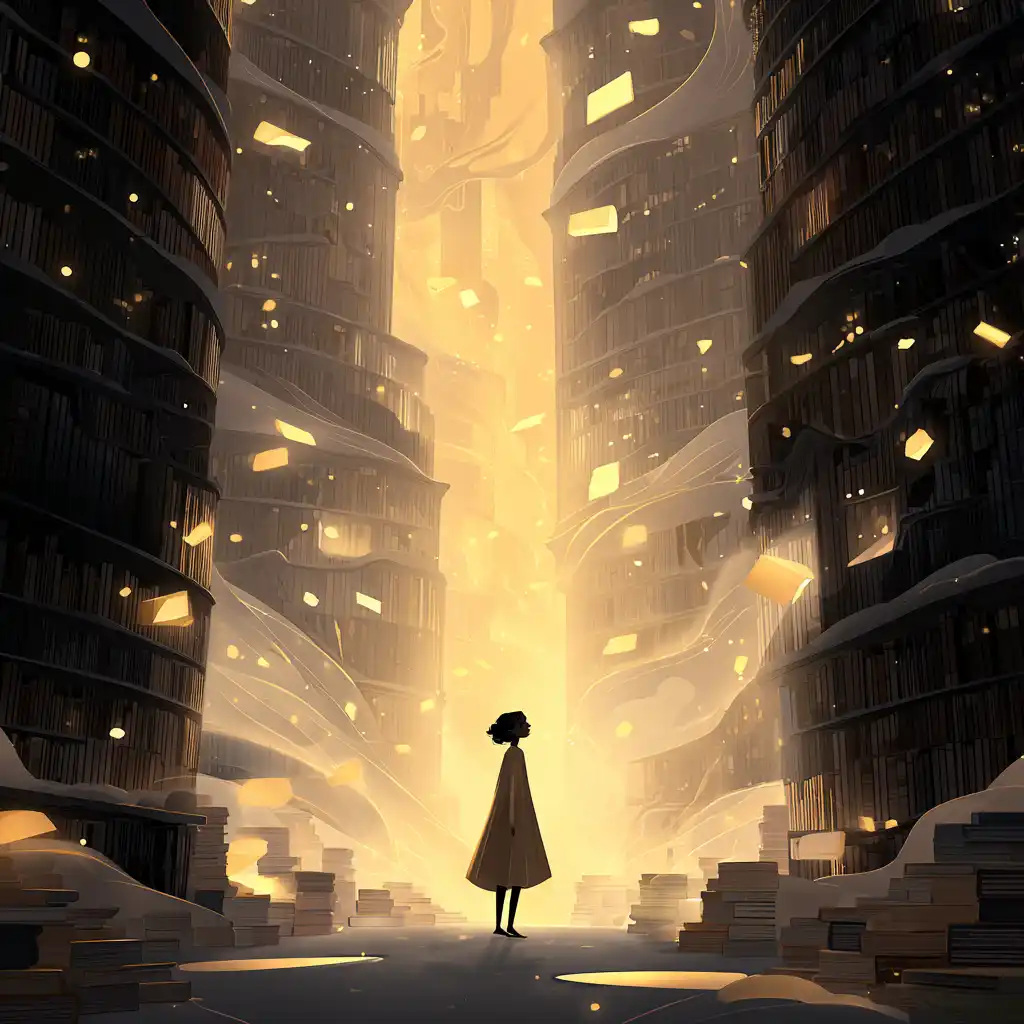
She walked between shelves so tall they disappeared into darkness. The books were covered in fine, silver dust, their titles half-erased, written in alphabets she didn’t recognize. Yet one thing was certain — they were whispering. It wasn’t the sound of paper or wind. It was language, soft and rhythmic, like breathing. When she listened closely, she thought she could hear words forming her name.
At the center of the room stood a large reading table made of marble. Dozens of open books lay on it, their pages turning on their own, as if touched by invisible hands. Mira hesitated. Something about the place felt both sacred and dangerous, but curiosity was stronger than fear. She picked up the nearest book.
Warmth spread through her fingertips. The leather cover was pulsing, and the letters inside were glowing faintly, rearranging themselves as she read. The story described a world where the ocean was made of glass and where ships sailed on reflections of the moon. The longer she read, the clearer the images became, until she could almost hear the waves breaking against her own thoughts. She smelled salt, felt wind, and forgot for a moment that she was standing in a room of shadows.
She read for hours without realizing it. The light outside the windows had changed to a pale blue dusk. When she looked up, something was wrong — the shelves behind her were empty. The books she had already read had vanished, leaving behind thin lines of smoke curling into the air.
Heart racing, Mira ran toward the librarian’s desk, but no one was there. Only a single note lay on the counter, written in trembling ink: “Every world that is read demands sacrifice.”
The words burned in her mind. She understood then that the library itself was devouring stories — consuming them to keep its ancient magic alive. If she continued, her own world might vanish too.
Yet part of her couldn’t stop. What if the next book held an answer? What if there was a way to free the lost stories? Her hands shook as she reached for another volume. The pages turned before she touched them, showing scenes of a city of light, a tower of mirrors, and a girl who walked among fading worlds. The girl looked like her.
A sudden gust of wind swept through the hall. The candles went out. The silence broke into a thousand whispers. The shelves creaked and moved. She turned toward the exit, but the corridor was no longer made of stone. The floor had become parchment, and the air was filled with falling letters like snow. Words were forming sentences in midair. The walls were rewriting themselves faster than she could read them.
Panic rose in her chest. Her memories — her home, her mother’s face, her childhood streets — were forming into glowing text, dissolving as she reached for them. She understood that once her story was finished, everything she had ever known would cease to exist.
Still, a strange calm settled over her. Maybe this was how stories lived — not written, but lived and then forgotten.
She returned to the black table. The last open book waited. Its page was blank except for one line slowly appearing in gold:
“Every story ends where it began.”
She looked up — and saw her own name written across the final page.
The whispering stopped. The shelves stood full once more, but the book in her hands was gone. The air smelled of ashes and ink again, as if nothing had happened.
But Mira was no longer there. She had become a story — her body, her memories, her entire life written into the library's endless collection.
Some say the library still stands at the edge of the city. And sometimes, when the wind moves through its broken windows, it carries a voice — a quiet, familiar whisper, telling the story of Mira.