Liam had never considered himself a sporty person. At school, he often avoided PE class, and as an adult, his idea of exercise was walking a little faster when he was late for the bus. He didn’t think much about fitness until one Monday morning when he became breathless after climbing only two flights of stairs. His heart was racing, his face turned red, and he needed a whole minute to recover. The elevator wasn’t broken, he had simply decided to “be healthy” and use the stairs. That short climb left him embarrassed and thoughtful, and it made him realise that his body wasn’t as strong as he had assumed. Something needed to change.
Later that day, he put on an old pair of trainers, tied his laces tightly, and walked to the park. The weather was pleasant, and the fresh air gave him some energy. He found a playlist of upbeat music, warmed up briefly, and began to run. For the first thirty seconds, he felt proud. By the one-minute mark, his breathing became heavy, and his legs already felt tired. After one minute and fifteen seconds, he slowed to a walk, trying to hide his frustration. “Walking is part of running,” he told himself. He tried twice more, but each run was short. When he got home, he felt exhausted and discouraged.
The next morning, his friend Mark called. When Liam explained how difficult the run had been, Mark suggested something different. There was a beginner-friendly fitness class at the community gym that evening, and he invited Liam to join him. It was supposed to be a mix of light cardio and simple strength exercises. Liam agreed, partly because he trusted Mark, and partly because he didn’t want to give up after just one attempt.
At the gym that evening, Liam noticed people of different ages and fitness levels. Some looked confident, others looked unsure, and a few seemed confused. The instructor, a cheerful woman named Sarah, welcomed everyone and explained that the class would include several basic exercises. Liam joined the warm-up, and within a minute he was sweating. The exercises were simple but tiring. He struggled during step-ups, almost fell during a short plank, and had trouble coordinating his arms and legs during jumping jacks. Still, he completed the class. When it was over, he felt tired but also proud that he he hadn’t left halfway through.
The next day, his muscles were sore, and he moved carefully, but he returned to the class with Mark. It wasn’t easier, but he began to recognise the exercises and understand his limits. After the third class, he didn’t need to stop as often, and by the fourth class he was able to hold a plank for twenty seconds. It wasn’t much compared to others, but it was twice as long as before. Mark told him he was improving, and Liam couldn’t deny it. He still didn’t think of himself as “sporty,” but he was slowly becoming more consistent.
A week later, he went back to the park to run again. He warmed up properly this time, set a slower pace, and focused on keeping his steps light and steady. He passed the one-minute mark without problems, then two, then three. When he reached five minutes, he felt surprised and pleased.
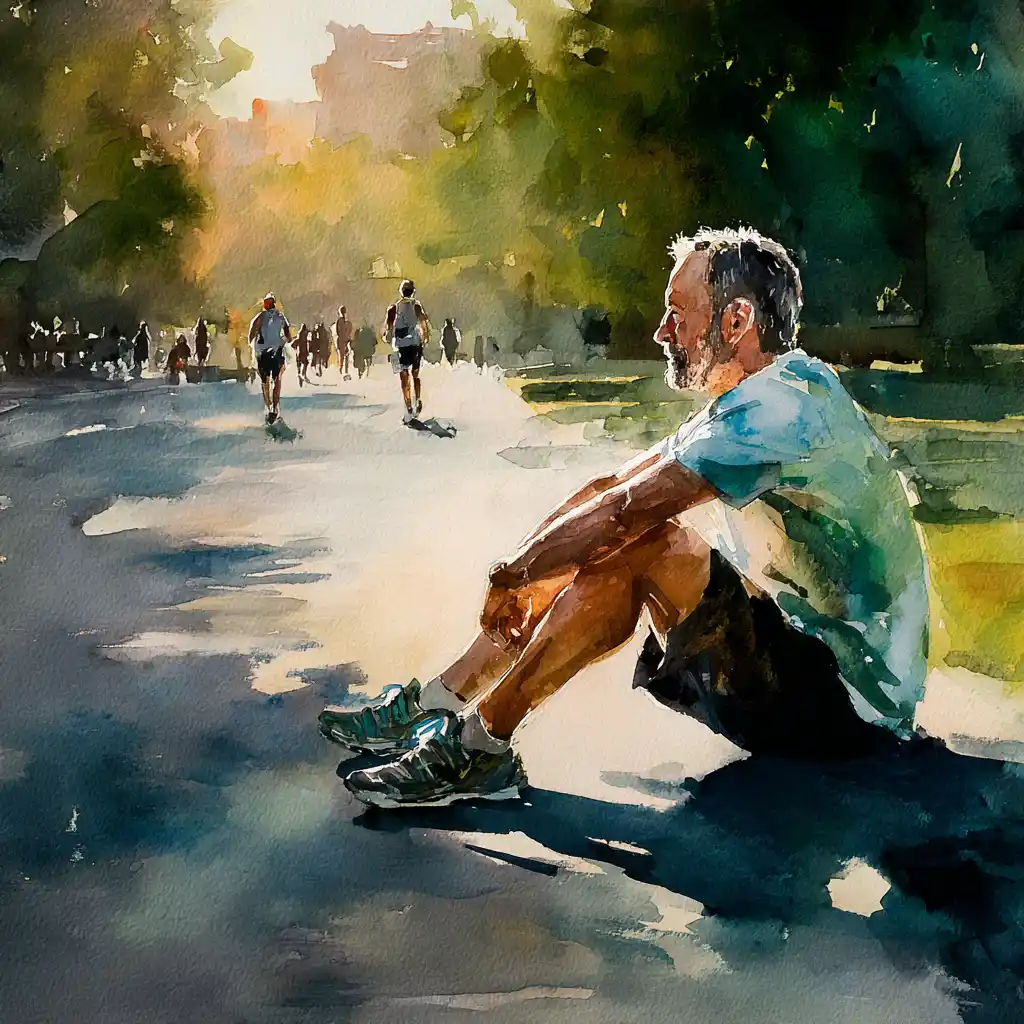
He turned onto a quieter part of the path. A group of people stood ahead, talking and blocking one side. Liam moved to the left to pass them, not noticing the uneven edge of the path. His foot landed at the wrong angle, and his left ankle suddenly twisted. There was a sharp pain that forced him to stop. His eyes watered as he felt a strong wave of disappointment. He remained seated for a moment, hoping the pain would ease, but the ankle soon became swollen.
He managed to get a taxi home. At his apartment, he put ice on his ankle and tried to stay calm. He paused his gym classes for a week. The sadness stayed with him, but it slowly changed into a thoughtful mood. He knew he wanted to continue, but he also knew he needed proper technique.
By the end of the week, his ankle felt better, though still sensitive. He looked at his running shoes and realised he didn’t want to repeat this experience. He decided to invest in a few sessions with a personal trainer. It was a quiet promise to himself — he wanted to learn the basics properly and continue wisely.
When he finally returned to the park, he didn’t run. He walked slowly along the path and watched others moving at their own pace. For the first time, he didn’t feel behind. He felt like someone who had started a journey and was learning how to continue it wisely.